100% customisable travel idea
First steps in China Beijing, Xi’an, Shanghai and the Dragon’s Teeth
China - Beijing - Xi'an - Yangshuo - Longsheng - Shanghai
To the four corners of China
Your journey
Your first accommodation is a siheyuan, a courtyard residence that is emblematic of old Beijing. The latest, one of the skyscrapers that have redimensioned Shanghai. A whole history of China between two accommodations. In the meantime, another high-rise, a house by the water and a chalet in the green hills of Longji. Each stop-off has its own atmosphere and its own justification. Urban here, pastoral there. Everywhere, the expected comfort is provided, bearing in mind that conditions are not quite the same in the capital and in the rice fields of Guangxi. The experiences we have included in your itinerary reflect the astonishing variety of travel: Forbidden City, Great Wall, the buried army of Qin Shi Huangdi, karst peaks of the Li Valley, terraced rice fields and Shanghai in the era of the Blue Lotus bleu. Quite a programme! Around this, which we consider essential, there is still time to pursue your own explorations, take advantage of the circumstances or simply do nothing. Private guides accompany you whenever explanations, directions or advice are needed. To travel from one site to another, train and plane. China is a big place. On site, you'll find suitable means of transport, from the metro to bamboo rafts. Logistics should never derail the atmosphere. And if you wish to try your hand at calligraphy, taste some of Xi’an’s street food or experience digital art in Shanghai, simply let us know. Along the way, an unexpected whim or a minor setback may arise; you have the contact details of our on-site Concierge service to respond.
Itinerary
100% customisable for you
Night on board, arrival the next day.
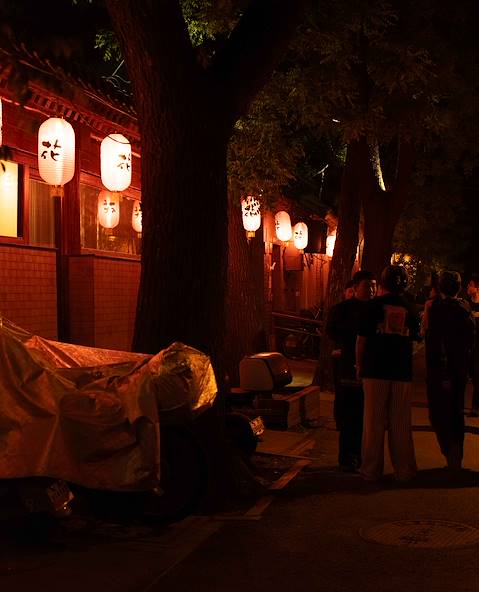
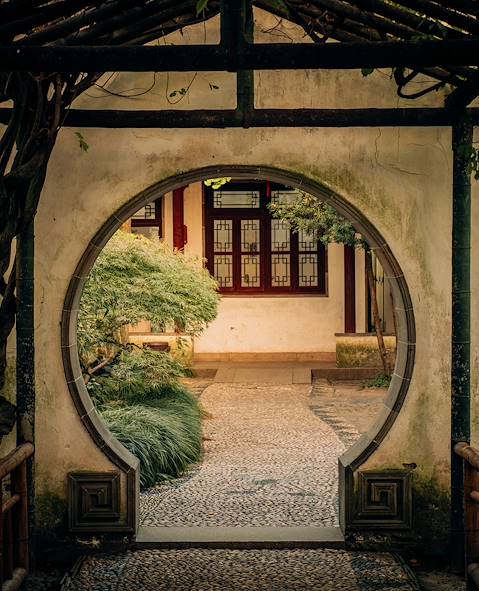
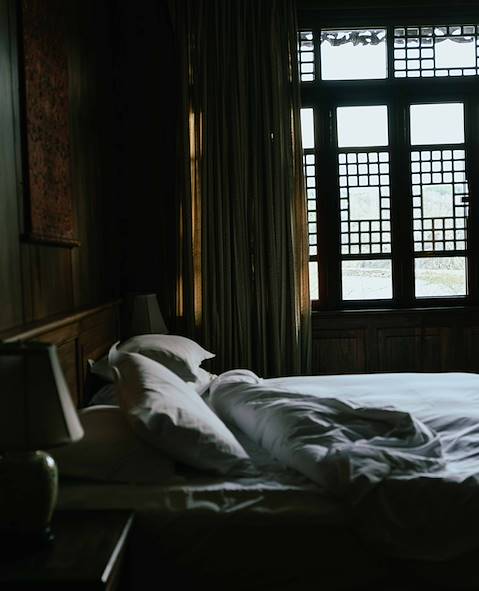
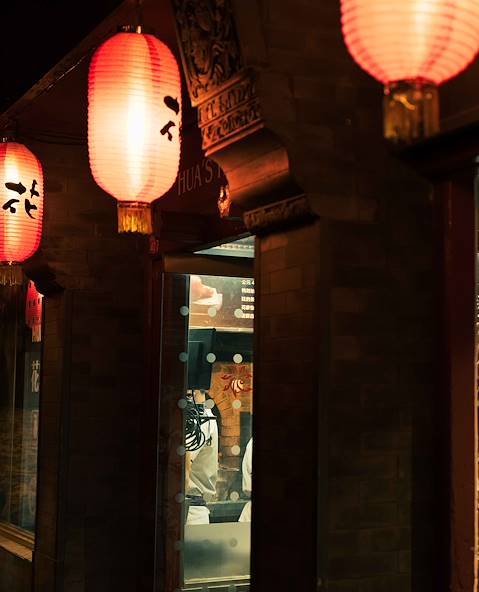
After your private transfer, you’ll check in for four nights in the southwest of Chaoyangmen, in the centuries-old Yanle hutong. So here we are in what remains of old Beijing. The buildings are arranged in the classic way around a square courtyard. The tones are the traditional grey. The whole place has been beautifully restored. The rooms are well-kept, comfortable and charming. They combine Chinese motifs (structural elements, furniture) and imported styles, yet the atmosphere remains unmistakably Beijing. At the right times, it’s truly pleasant to spend time in the courtyard or on the rooftop. On site, a restaurant: family-style Chinese cuisine. There is also a bar. To tour around the neighbourhood, the establishment rents out bicycles.
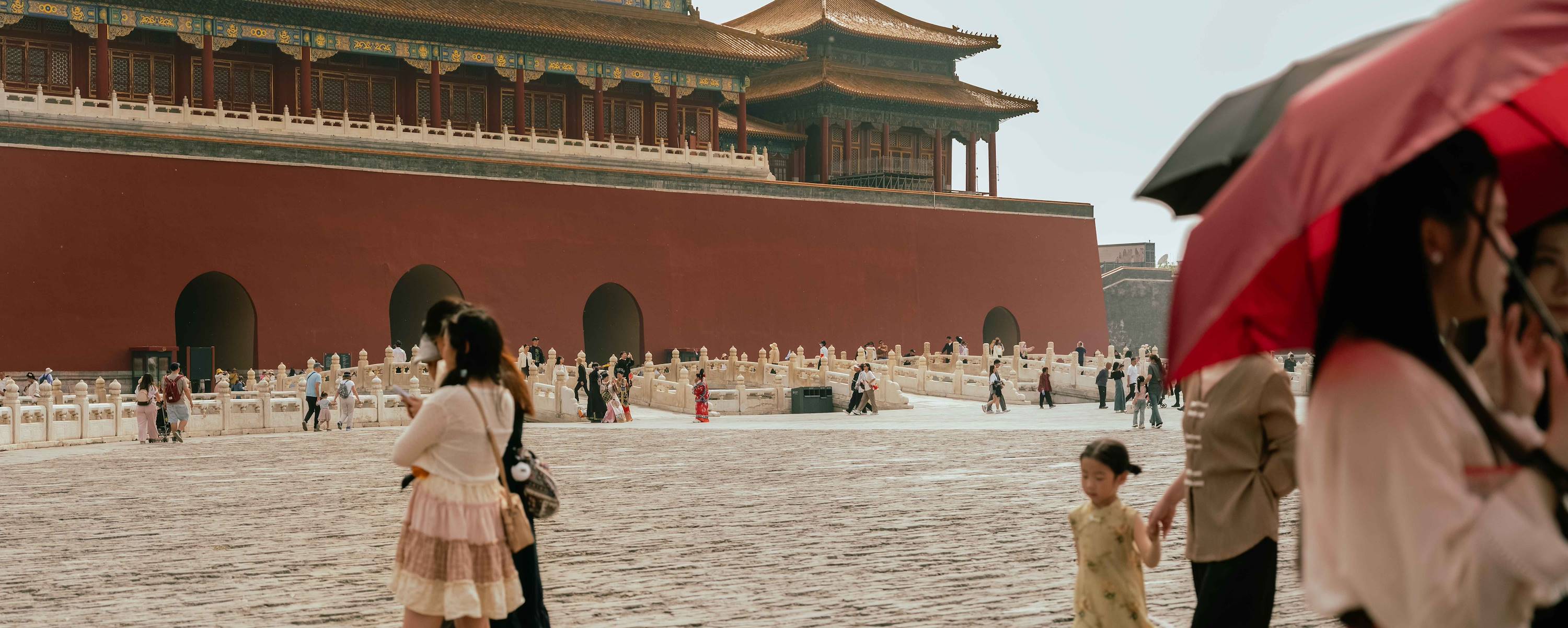
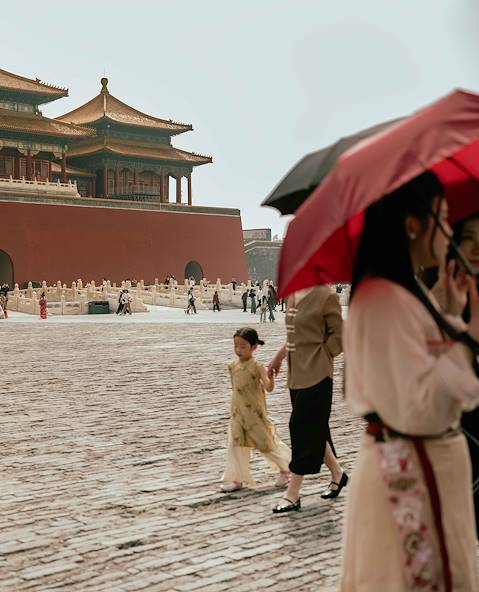
Scheduled - Tian’anmen Square and the Forbidden City. This very large esplanade can feel a little disorienting. There is the Gate of Heavenly Peace, Mao’s Mausoleum and the Monument to the People’s Heroes, but it is helpful for the private guide to remind visitors of the major events that took place here: the May Fourth Movement in 1919, the proclamation of the People’s Republic on 1 October 1949, the launch of the Cultural Revolution on 18 August 1966. And others - no less important. The crowds, whether mobilised or self-mobilising, gather in Tian’anmen Square. The Forbidden City is no longer off limits. The former imperial palace is now a museum, whose purpose is to recall the greatness of Chinese civilisation. Through the scale, nobility and coherence of its design, and the splendour of its collections, it achieves this with ease. The nerve centre of the Ming and Qing empires, yet also a world unto itself, it is an achievement whose full significance is difficult to grasp. It retains much of its mystery, offering visitors the chance to imagine what lies beyond.
Today, you can start by visiting the Temple of Heaven, a remarkable witness to imperial worship from the 15th to 18th centuries. The Confucius Temple, founded at the beginning of the 14th century during the Yuan dynasty, has welcomed both elite and humble scholars who came to pay tribute to the great sage. After turning his personal residence into a lamasery, Emperor Yongzheng of the Qing dynasty brought great prosperity to Yonghe Temple in the 17th and 18th centuries. You can still see it today. The Phoenix Center - Shao Weiping, 2014 - shows that Chinese architecture has ambition, resources and vision. You can also explore the performing arts and attend a Peking opera performance - an acrobatic theatre with singing that brought the hutongs to life in their heyday. And, among the many culinary options, you can opt for Peking duck. In Beijing, it’s something else!Optional - Introduction to calligraphy.
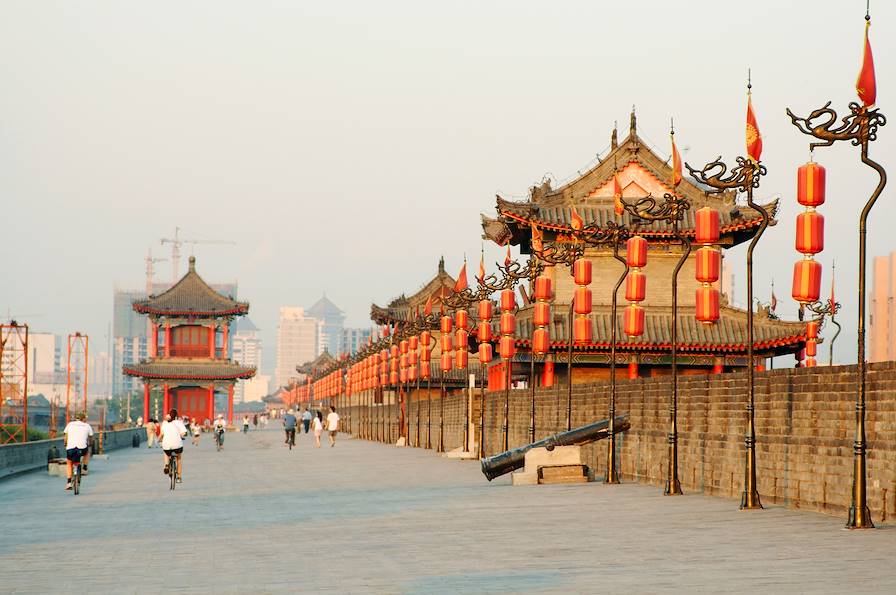
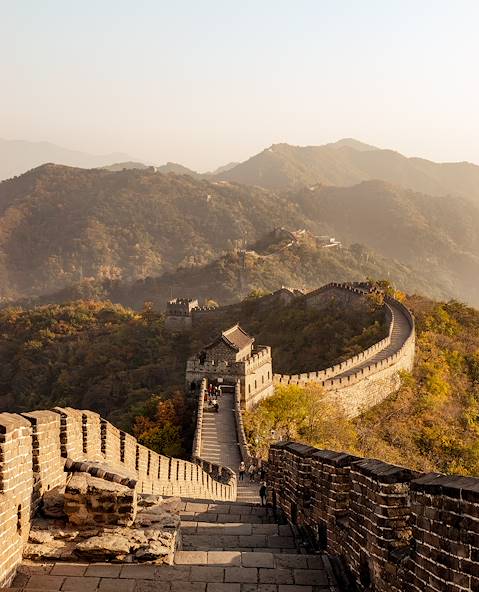
Scheduled - the Great Wall at Mutianyu. With a driver, you’ll spend a day at the Great Wall. 70 km (43 miles) northwest of Beijing, the Mutianyu section is one of the best built and best preserved, with easy access by cable car. In its current form, it dates from the 16th century. Ming dynasty. Once you have climbed up to the ramparts, stroll along; from the watchtowers, you can take in the rolling landscape and the dense forest cover, which no doubt made it easy for barbarian incursions. There’s no invasion to fear today, so you can head back on a wheeled cart down a long slide. Incidentally, you will notice that the engineers who designed it equipped the wall with battlements facing outwards, but also inwards. It’s striking to think that the people in the security barriers watched those they protected just as much as those they protected against!
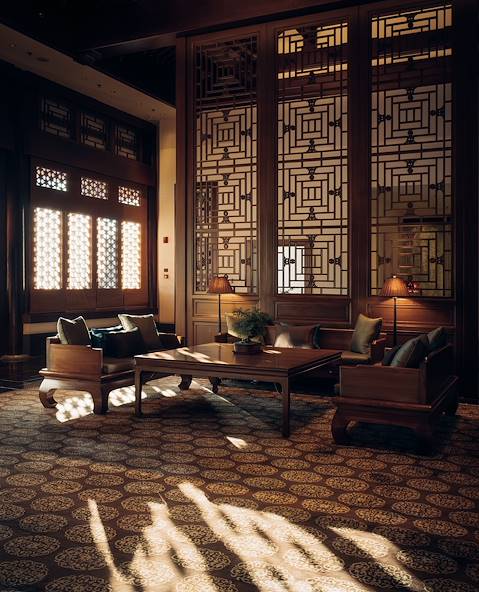
You’ll take a private transfer to the station, then a train to Xi'an. After another private transfer, you’ll settle in for two nights in the old town, Xincheng. It’s a large modern establishment, typical of travel in today’s China. The gardens overflow with greenery and offer plenty of quiet spots. The sparkling grand hall takes your breath away. The rooms have a beautiful, classic and comfortable look, with Chinese patterns enhancing the overall elegance. At the main restaurant, Shaanxi cuisine meets French technique. They have a lot to say to each other. Carnivores will find a churrascaria on site. The lounge has a cocktail section and another for a winebar. For relaxation of both body and mind, guests have access to a large indoor pool, massage rooms and a gym area. The highest international standards are met in every respect. A few minutes’ walk will take you to the iconic Bell and Drum Towers. 14th century, Ming dynasty.
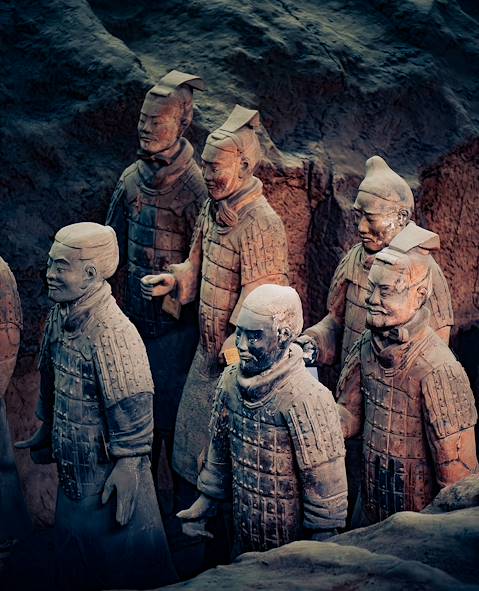
Scheduled - The buried army of Qin Shi Huangdi. The thousands of terracotta soldiers that form the post mortem guard of the great emperor are world-famous. Together, they form a monument of exceptional scale, a milestone in how death is symbolised in China and a remarkable stop in the history of sculpture. We have seen them in detail in many different circumstances, but when brought together, they have incomparable evocative power. And when gathered together, that power is in Xi’an. Well also visit the Muslim quarter, Hui, with a private guide. First, the grand mosque. Founded in 742 during the Tang dynasty, it was rebuilt in the 14th century. The adaptation of Chinese architecture to the requirements of Islam has produced a result of great beauty. Finally, you’ll be invited to a shadow theatre performance in the Gao family residence, a gem from the Ming and Qing periods. This form of performance has been inscribed by UNESCO on the Intangible Cultural Heritage of Humanity list. Optional - street food in Xi’an.
Private transfer to the airport. Flight to Guilin. You’ll drive to Yangshuo with a private guide. You’ll then stay for two nights on the Yulong River (tributary of the Li) in a simple, welcoming hotel. The rooms overlook the water and the countryside; the furniture was made from bamboo by local artisans. The establishment is committed to the values of participation and sustainability. The chef shops at the market with local farmers and creates tasty seasonal local dishes. A pizza oven adds a universal counterpoint. Yangshuo, on the banks of the Li River, now attracts many travellers (but there are crowds everywhere in China). The site remains remarkable: its geology sets the stage for the spectacle you will experience tomorrow in the surroundings of Xingping. And your accommodation, set a reasonable distance from the commercial district, ensures a peaceful stay.
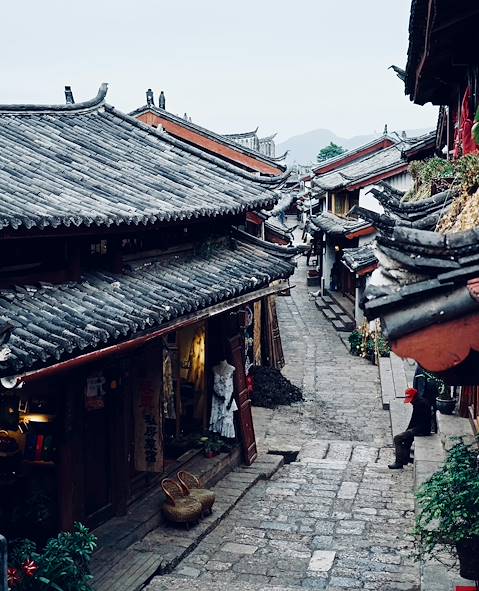
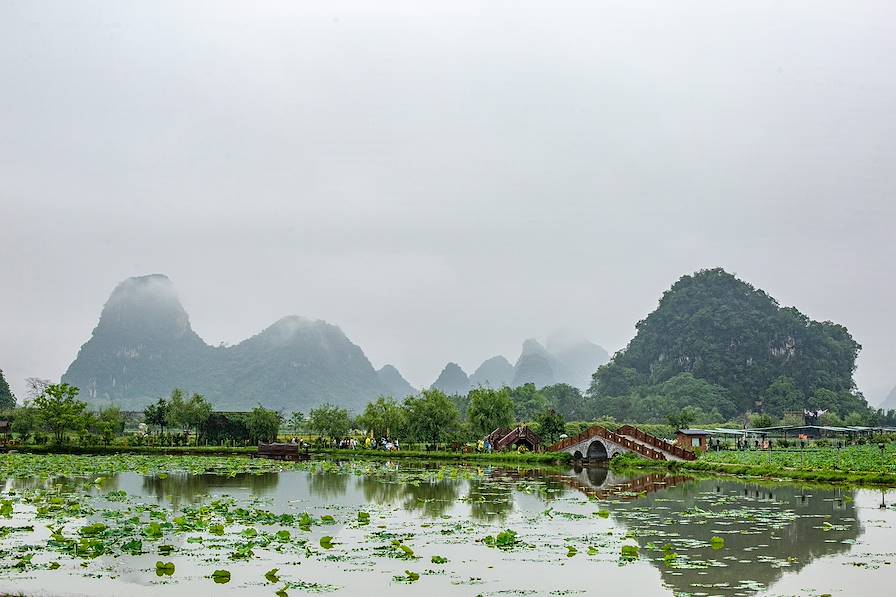
Scheduled - Rafting on the Li. After a road transfer, you’ll board at the village of Xingping (security equipment provided by the organisation), away from the swarms of tourists. The landscape of karst peaks, so characteristic of the valley, is breathtaking: dragon’s teeth jut out everywhere, and the mythical creature seems to have chewed on spinach, the vegetation is so dense. On the calm waters, cormorant fishing is still practised. Geological contemplation is complemented by observing life along the riverbanks. If this landscape reminds you of some of the great themes of shanshui painting, there’s a good reason. With the guide, you’ll also visit the village. Its main street, with its traditional one-storey brick houses, still evokes the China of days gone by.
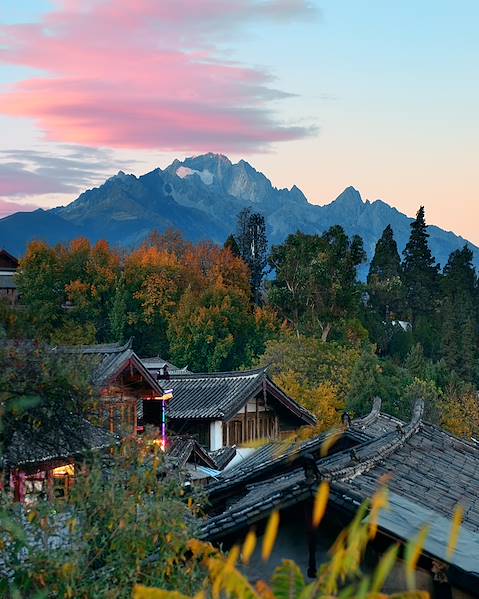
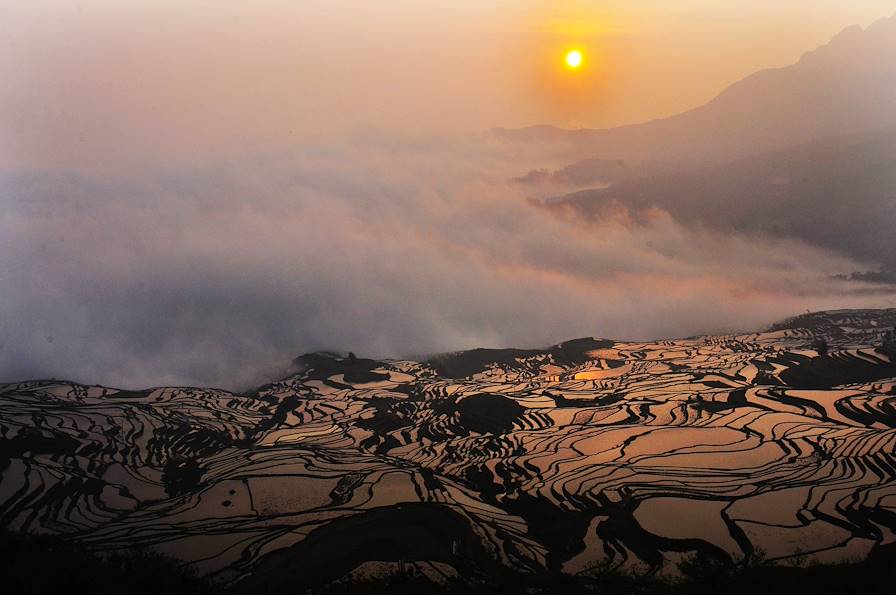
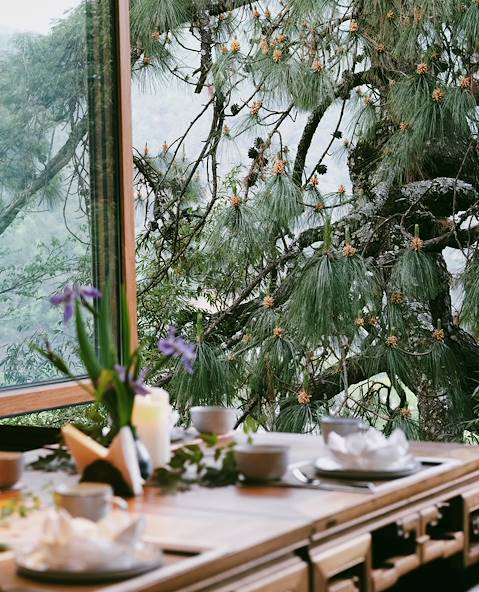
Scheduled - the Longji terraced rice fields. You’ll drive to Longsheng. It is an extraordinary cultural landscape. The rice terraces, running along the slopes, seem to trace contour lines, while the water adds a shimmering effect. The high hills, ranging from 600 to 800 metres, have been sculpted with a meticulousness whose regularity over such distances is hard to explain. It is nothing short of miraculous. A persevering prodigy, representing an incredible amount of work. The first pickaxe blows were struck in the 13th-14th centuries. Such a system still requires truly considerable maintenance work today. Land art that didn’t realise it could be called that. The visit will be accompanied by a private guide. Then you’ll stay overnight in the heart of the scenic area. The hotel brings together all types of regional wood. The result - a kind of large Chinese-style chalet - offers travellers a pleasant experience with various wooden charms. The countless ways of working with wood for construction and décor add to the pleasure of living here. In addition to all the usual amenities, your room also has a balcony overlooking the valley.
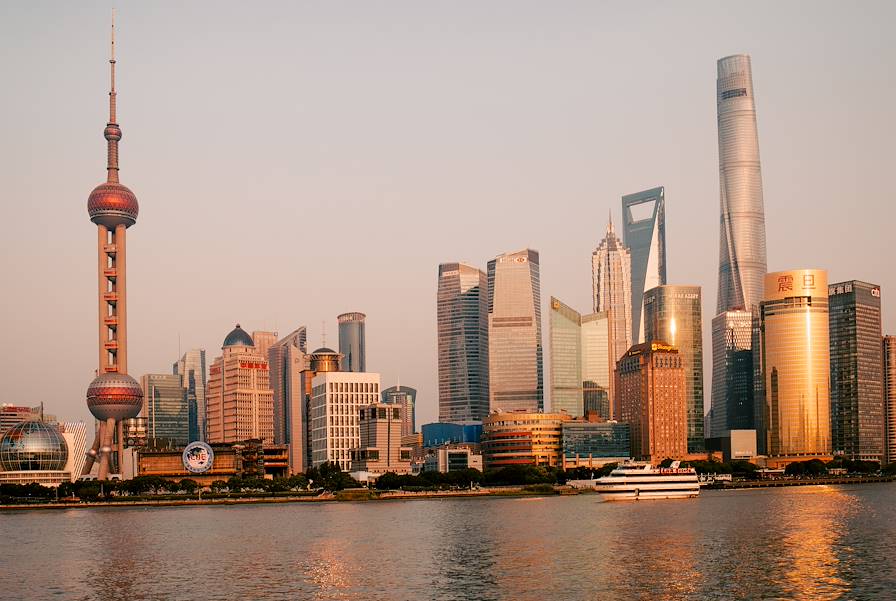
Drive to Guilin Airport. Flight to Shanghai. Private transfer and check-in for two nights in the Huangpu district, on the edge of the old Chinese city. A contemporary building that sits in Shanghai’s skyline like a sugarloaf in Yangshuo’s - what could be more natural. Inside, the international style is flawless. The rooms are thoughtfully designed and very comfortable. Advances in glass treatment now make it possible to fit bathrooms with large picture windows and place a bathtub in front: splash, privacy and a view of the city. The restaurant serves international cuisine. And the spa service is most welcome at this stage of the journey.As a neighbour, or almost, you can take a stroll in Yu Garden, a 16th-century landscape masterpiece, before being swept up by the vibrant contemporary energy that is now part of Shanghai’s culture.
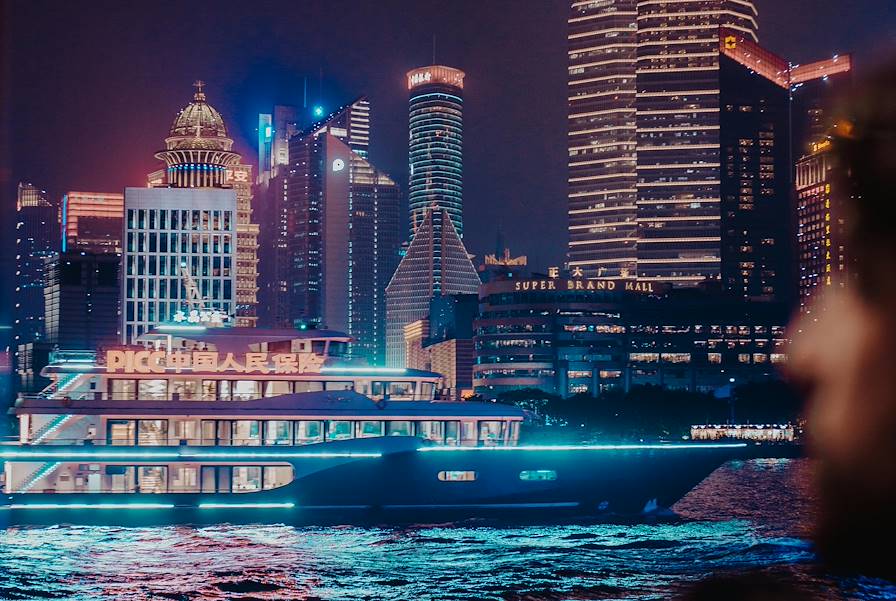
Scheduled - Shanghai, following in Tintin’s footsteps. The Shanghai of the 1930s is back. Long overshadowed as the epicentre of concessions, opium and all sorts of shady dealings, the city of Big-Eared Du is once again reclaiming its place. For roughly the same reasons that led to its exile. It must be said that for better or worse, its power to fascinate has never faded. Finally, Tintin came here (“The Blue Lotus”) to stand up for justice. Hergé was helped in this by Zhang Chongren. This brought a new sense of authenticity to the album. Accompanied by a private guide, you’ll stroll through the highlights of Shanghai from that era. They are often the subject of thoughtful renovations. French Concession, International Concession, the Bund - the narcotic and jazzy Far East of the young reporter and Zhou Xuan is now set against the achievements of the People’s Republic. Optional - EPSON teamLab Borderless Shanghai.
Private transfer to the airport and international return flight. Night on board, arrival the next day.
À la carte
This suggested itinerary can be customisable down to the smallest detail, including duration, stops and content. An à la carte menu of experiences is also available to create a journey that reflects who you are.
Introduction to calligraphy
You’ll meet the calligrapher in Beijing, near the Drum Tower in a traditional courtyard. The expert presents the history, principles and styles of Chinese calligraphy, then the tools to use, the famous four treasures of the scholar: paper, brush, ink and inkstone. Next, you’ll roll up your sleeves and practise drawing the main strokes that make up the characters. Finally, we write a few simple words. In doing so, we will have entered a vast cultural domain.Street food in Xi’an
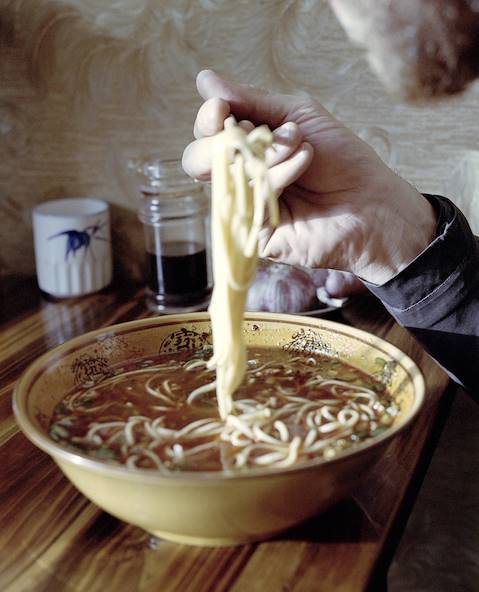
At lunchtime, people stroll through the streets to discover what delicious things are being sold. In the Muslim quarter, the sheep reigns supreme. It is eaten in soup (pao mo),sliced in a flatbread (rou jia mo), or as a filling for dumplings. Liang pi is a cold wheat noodle dish, served with raw vegetables, gluten, garlicky vinegar and chilli oil. Just as a few examples. And the influence of Central Asia can be felt in many sweet preparations: osmanthus and persimmon cakes (huang gui shi zi bing); glutinous rice with jujube (zeng gao); glutinous rice with honey (feng mizong zi); and so on.EPSON teamLab Borderless Shanghai
Getting lost and finding oneself in digital art. Here, this large-scale sensory experience is summed up. Computers, lamps, lasers, mirrors, entertainment, etc. Everything that can enhance the vision is implemented. You enter another world, without perceptible boundaries. Spaces multiply, change shape and colour, blur, regenerate and undergo a metamorphosis. And music accompanies these dazzling changes. First they leave you disoriented, then charmed, and finally carried away. If you tune in to the changes of this electronic happening, you’ll experience a thrilling sense of freedom, in a parallel world that is, all in all, welcoming.
Why visit China with Voyageurs du monde?
Every day, our travel specialists craft bespoke experiences shaped around each traveller's profile, desires and budget. These passionate experts design experiences delivered on the ground by a local network of Concierges and trusted contacts. These fully customisable, made-to-measure trips are complemented by a wide range of high-end services (lounges, 24/7 assistance, travel booklet, app, Wi-Fi, restaurant booking, etc.)
Let us create your tripA few of the advantages of travelling with us to China
- Globally unique concierge service
- Gourmet Voyageurs
- Adjust your trip while travelling
- 24-hour assistance
- CO2 absorption