100% customisable travel idea
Valleys and Dzongs of Bhutan A High-Altitude Grand Tour
Bhutan
100% customisable travel idea
Bhutan
100% customisable for you
Late arrival; overnight stay at one of the airport hotels. Clean, classic contemporary and professional, the hotel offers a gym, spa and restaurant serving Indian and international cuisine. A functional, comfortable stop as part of your journey.
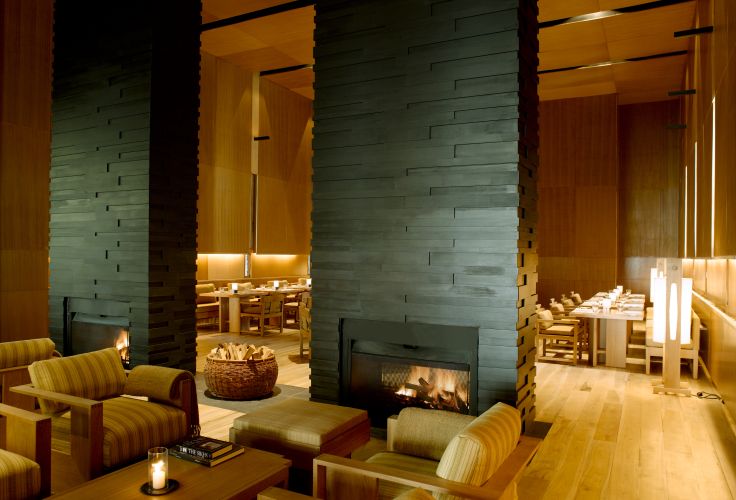
Flight to Paro. Transfer to central Thimphu. Check in for two nights at an elegant hotel whose recent design integrates Bhutan’s national architectural traditions. Vernacular motifs appear throughout, adapted to the needs of modern hospitality. Rooms are carefully styled, each with its own colour scheme: red ochre, pine green, pearl grey, aubergine and antique gold, and each with its own private balcony. In the restaurant, the chef prepares Bhutanese dishes alongside Indian, Thai and Chinese cuisine. The bar, with its raw wooden pillars and leather seating, skilfully blends British spirit with local design. The spa is refined and follows a holistic approach inspired by Ayurveda.
Meet your driver and guide.
Already included in your itinerary - Thimphu, the highlights. With your private guide, set out to discover a growing capital shaped by a clear rule: traditional Buddhist aesthetics must be respected, ensuring a strong sense of unity. The visit begins with an emblematic landmark - the Memorial Chorten, built in 1974 in memory of King Jigme Dorji Wangchuck. All white and topped with a golden spire, it is a symbolic representation of the Buddha. You will see many chortens during your journey, but this one has royal status. The colossal Buddha Dordenma is also linked to royal devotion and houses more than 100,000 gilded statues of Shakyamuni. The country’s centres of power are located within Tashichho Dzong, on the western bank of the river. Originally built in the 13th century, this fortress has been rebuilt several times following earthquakes and fires; in its current form, it dates from the 1960s and is an impressive, well-balanced structure. The National Library features a very pure Bhutanese style, and preserves multiple cultural treasures. Devotees often walk around it in circumambulation, as if it were a temple or chorten. Weather permitting, you can climb among flowers and prayer flags to a modest monastery offering lovely views over the valley.
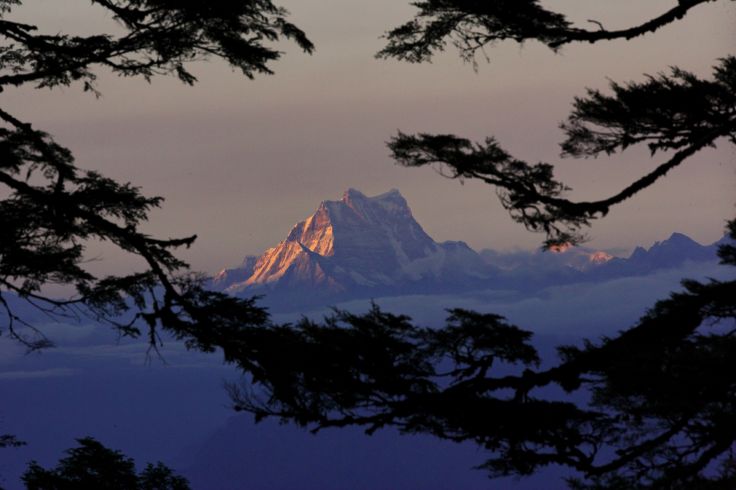
Drive to Gangtey via Dochula Pass, at around 9,843 feet (3,000 metres) above sea level. On a clear day, the Himalayan massif comes into view, rising as high as 24,934 feet (7,600 m) at Gangkar Puensum, a striking sight. Cypress forests, rhododendrons, magnolias and 108 chortens line the pass. Gangtey Monastery is a renowned sanctuary of the Nyingma school, rooted in esoteric tantric Buddhism; monks of this order wear red hats.
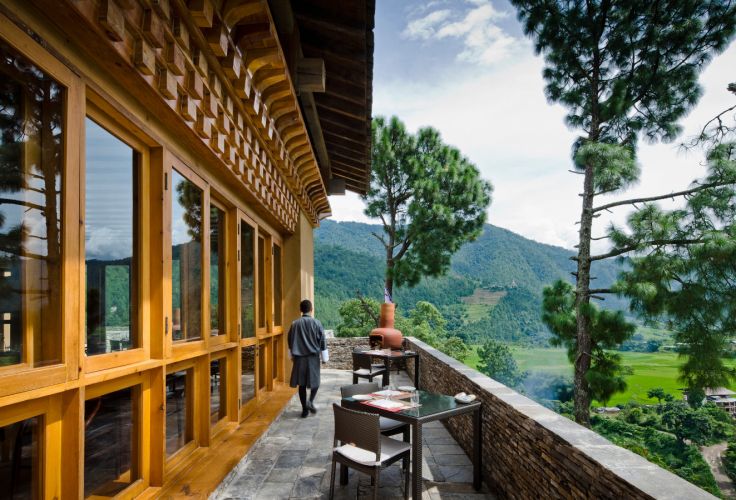
Overnight stay at a hotel that, at first glance, resembles an opulent farmhouse - though one that feels perfectly suited to a Himalayan retreat. Large windows in the bedrooms, lounge and dining room frame the valley as the central decorative element. Interiors subtly reinterpret Bhutanese motifs, turning simplicity and space into a form of luxury, where even the smallest object offers comfort. Swedish and British craftsmanship provide top-of-the-range wood-burning stoves and bathtubs, while in the spa, hot-stone baths and traditional Tibetan medicine work their magic. The cuisine is authentic and refined, perfectly showcasing high-altitude produce in Bhutanese and fusion dishes.
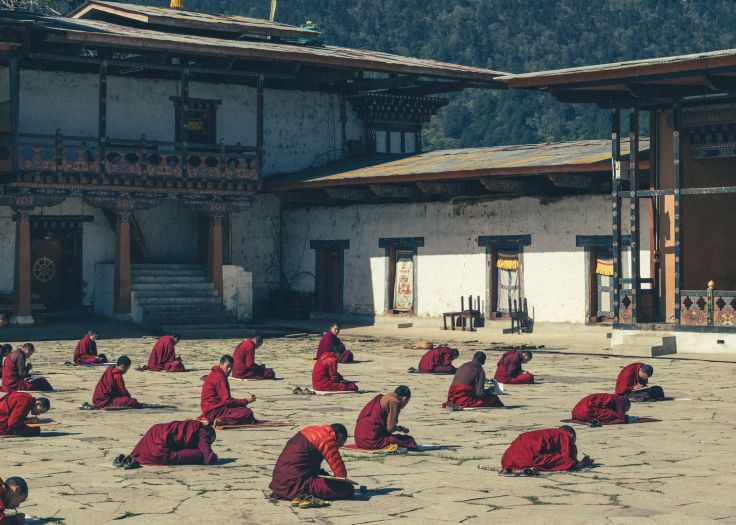
In your itinerary - Prayer and meditation at the monastery. The same evening, you are invited to an open meditation session, followed by a prayer with the monks in the shedra, the monastic school.
Visit Gangtey Dzong and the village, then drive on to Bumthang, this time via Pele Pass at 10,827 feet (3,300 metres). From here, on clear days, you can admire Jomolhari, north-west of Gangkar Puensum, rising to 23,950 feet (7,300 metres). Sacred in character, the mountain is believed to be the residence of one of the protective deities of Tibet and Bhutan. From Pele Pass, you are considered to have entered eastern Bhutan. You'll pass by the large Chendebji Chorten, built in Nepali style in the 18th century, then continue towards Yotong Pass at 11,483 feet (3,500 metres) before reaching Jakar.
Check in for two nights at a hotel made of grey stone, with beautiful painted wooden frames. Pine trees surround the property, with lovely views over the valley and the former royal palace of Wangduechhoeling, beside the Chamkhar River. Inside, wood and stone dominate once again. Rooms are simple and comfortable, heated by a bukhari wood stove, with a cosy chalet atmosphere. The restaurant serves Bhutanese cuisine that consistently places vegetables centre stage.
Already included in your itinerary - Jambay Lhakhang and Kurjhe Lhakhang. Legend has it that Jambay Temple was built in the 7th century, along with 107 others (including Lhasa’s Jokhang), to pin down a demoness who opposed the spread of Buddhism. The most recent buildings in the complex date from the last century, and its relatively low, compact form sets it apart. It has a special reputation for holiness. Kurjhe Temple, a royal necropolis, follows a more classical Bhutanese style and is also steeped in legend. Its origins are linked to an intervention by Guru Rinpoche - who introduced Buddhism to Tibet and founded the Nyingma school - on behalf of a former king of Bumthang. Incidentally, the cypress tree near the entrance is said to have grown from the walking staff of the second Buddha, and a cave enclosed within the sanctuary bears the imprint of his body. The oldest of the three temples dates back to the 17th century.
Drive to Punakha. En route, stop in Trongsa to visit the largest dzong in the country. Built on a rocky spur, Chökhor Raptentse Dzong stands high above the Mangde Chhu valley. It is the cradle of the Wangchuck dynasty, Bhutan’s ruling family. Its current dimensions date back to the 18th century. Administration, taxation and religion all coexist within this labyrinth of courtyards, corridors, galleries and buildings, large and small. A little further up, a watchtower has been converted into a museum dedicated to Bhutanese history.
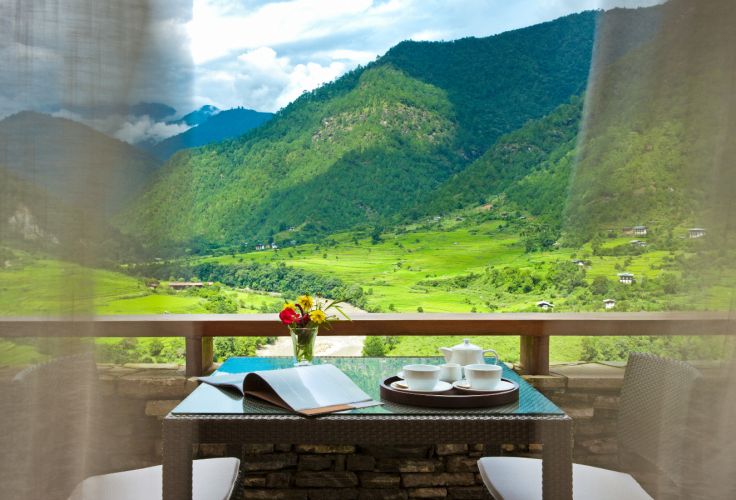
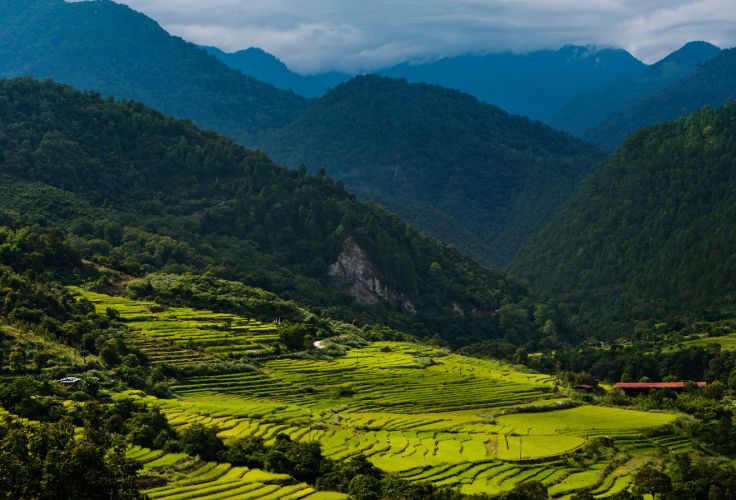
In Punakha, check in for two nights at a lodge overlooking the Mo River. The landscape of terraced fields winding through the valley - both dense and open at once - is striking. The hotel makes the most of it, with wide openings onto the scenery, while rooms feature floor-to-ceiling windows and terraces. Local stone and wood give the buildings a natural, grounded feel. The facilities offer comfort on several levels: practical, aesthetic and more. In a setting like this, the spa had to be exceptional. In the restaurant, the wagyu burger delivers robust flavour, the momos are delicious, the tofu fondue energising and the Himalayan ema datshi completes the menu.
In your itinerary - Chimi Lhakhang and the Khamsum Yulley Namgyal Chorten. A walk of around 40 minutes through villages and rice fields leads to Chimi Lhakhang, built at the very end of the 15th century in honour of the “Divine Madman”, Drukpa Kunley. Square in shape, the temple is preceded by a row of prayer wheels. The walk continues towards an impressive chorten built on the initiative of Queen Mother Tshering Yangdon Wangchuck. The Khamsum Yulley Namgyal was conceived to bring peace to Bhutan and to the world. The return journey takes you through open countryside.
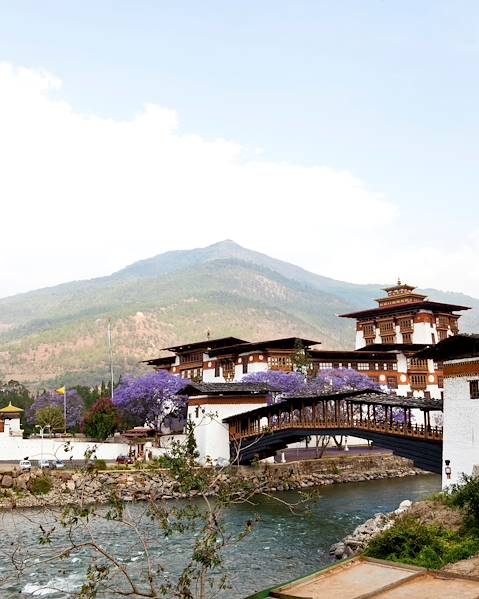
Also included - Punakha Dzong and the suspension bridge. Built in the 17th century between the male river Pho Chhu and the female river Mo Chhu, Punakha Dzong occupies a strategic position and is one of the country’s most majestic and meticulously restored administrative fortresses. It is astonishing to see so much power combined with such delicacy. The suspension bridge, 984 feet (300 metres) long, links the dzong to the town of Punakha across the Pho Chhu. The crossing is not dangerous, but can feel slightly daunting, given the scale and gentle sway of the structure. The reward is the superb panoramic views.
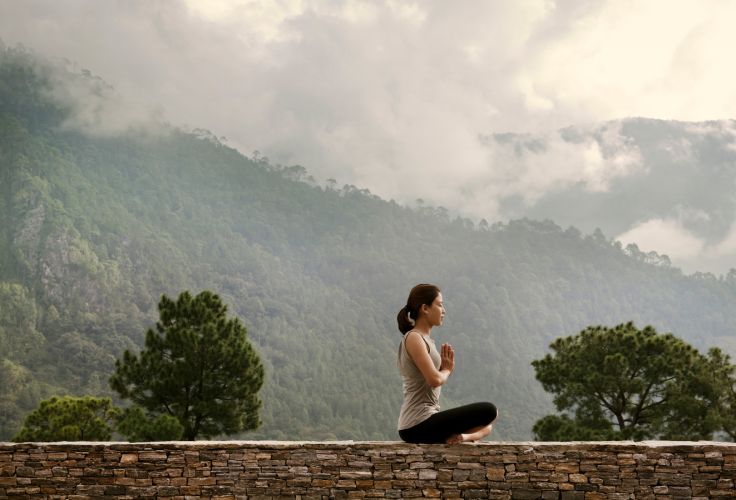
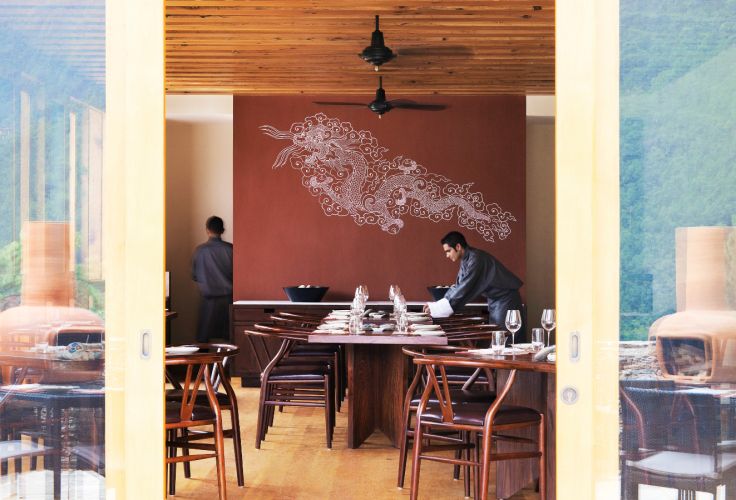
Drive to Paro. The route is via Dochula Pass once again, with renewed reminders of the sheer scale of the Himalayas. Check in for two nights at the Neyphu Valley hotel. The property is a fine example of Bhutanese building traditions adapted to the demands of modern living and hospitality: a garden courtyard, light wood throughout, large windows, fluid spaces and fine local craftsmanship. Rooms have the same welcoming simplicity you will have come to appreciate during your trip. In a holistic approach, every element of the house contributes to overall well-being, guided by the idea of zatsang, family. On site are yoga and meditation studios, a spa drawing on ancient healing traditions, and a beautiful indoor swimming pool. In the restaurant, ingredients follow a farm-to-table philosophy, and paired with refined techniques. The result is outstanding.
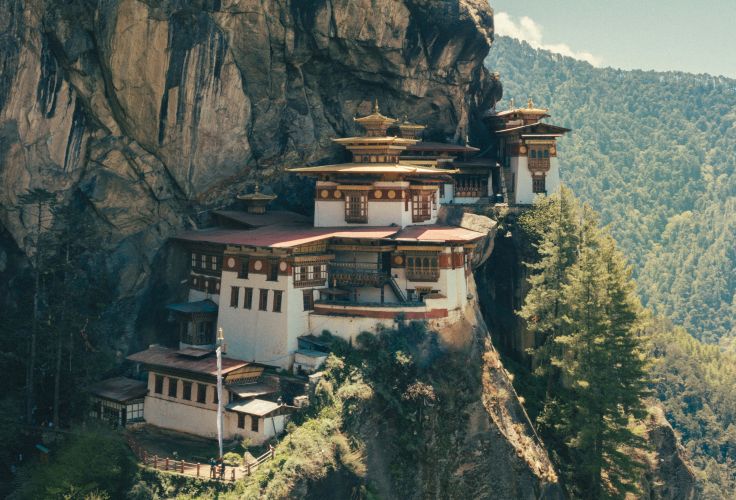
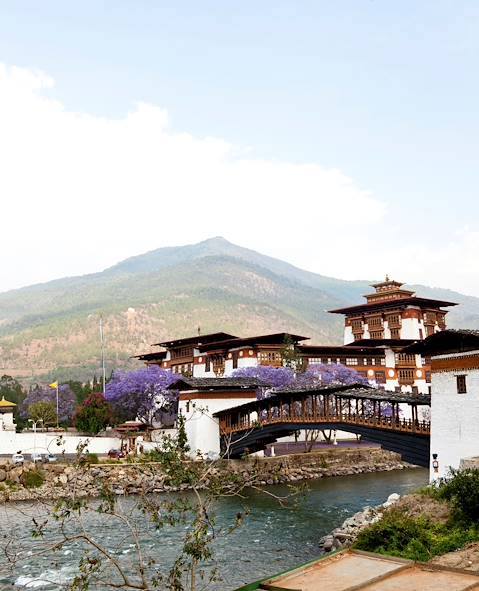
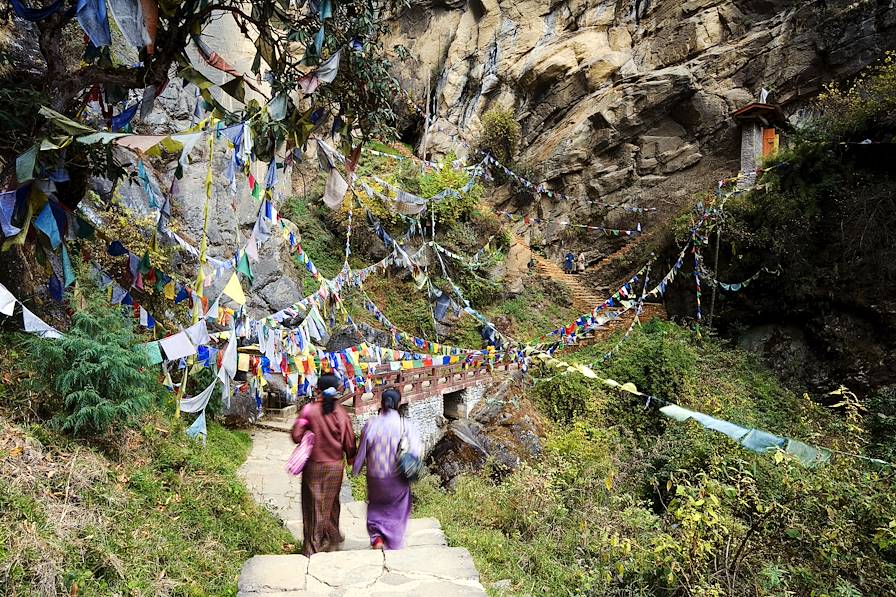
In your itinerary - Paro Dzong and the “Tiger’s Nest”. The origins of Rinpung Dzong, which overlooks the Paro Chhu valley, date back to the 10th century, although its current five-storey form was only completed in the 17th. A watchtower of the same period, the Ta Dzong, now houses Bhutan’s National Museum of Art. Together, these visits complement those in Punakha perfectly. At the foot of Rinpung Dzong, a covered bridge spans the Paro River. Taktsang Gompa, the “Tiger’s Nest”, clings to the mountainside some 2,297 feet (700 metres) above the valley and is one of Bhutan’s most spectacular sacred sites. The way the buildings are stacked on such a narrow base gives a vertiginous effect. The climb is a little challenging, but the gradual reveal of the site through the mist is well worth the effort. On the way back, you visit Kyichu Lhakhang, whose history dates back to the 7th century, making it one of the country’s most revered and precious temples.
You then bid farewell to your driver and guide.
Transfer to the airport and flight to Delhi. An English-speaking driver and vehicle are at your disposal for the day, with daytime access to a hotel near the airport.
Already included - Old Delhi by rickshaw. The rickshaw - a motorised three-wheeler - is an Indian institution and an efficient way to move around the city. It is therefore aboard one of these vehicles, accompanied by a private English-speaking guide, that you explore Old Delhi. The visit begins with Jama Masjid, the great mosque, a Mughal masterpiece with three domes and twin minarets whose vast scale reflects the importance of Islam in India. You’ll also see the Red Fort, the imperial residence built between 1638 and 1648, and now a UNESCO World Heritage Site. Along the way, Hindu temples, mosques and Christian churches appear side by side, before you reach Khari Baoli, Asia’s largest spice market. It is an assault on the senses, rich in colour and aroma, and has operated continuously since the 17th century.
At the end of the day, private transfer back to the airport and return flight. Night on board, arrival the next day.
This suggested itinerary can be customisable down to the smallest detail, including duration, stops and content. An à la carte menu of experiences is also available to create a journey that reflects who you are.
Every day, our travel specialists craft bespoke experiences shaped around each traveller's profile, desires and budget. These passionate experts design experiences delivered on the ground by a local network of Concierges and trusted contacts. These fully customisable, made-to-measure trips are complemented by a wide range of high-end services (lounges, 24/7 assistance, travel booklet, app, Wi-Fi, restaurant booking, etc.)
Let us create your trip
Travel with complete freedom, guided by your interests,
ideas and passions.
250 travel specialists, organised by country and region. Driven by a passion for beauty and never short of ideas, they inspire you and design an ultra-personalised journey: itineraries, accommodation, workshops, encounters, and more.
Always at your service: with a dedicated travel specialist, Concierge service and 24/7 assistance, our teams support you and adapt in real time, for a trip that is both flexible and expertly supported.
With family, as a couple, in a group of ten, on a road trip, by train, by boat, for a weekend or a round-the-world journey... Trips tailored to your preferences, enhanced by clever services, for ever smoother travel.